The neighborhood’s character is more than a single-family story.
A closer look at Beverly-Fairfax’s period-revival multifamily homes, the history behind their recognition and what buyers and owners should ask beyond the architectural label.
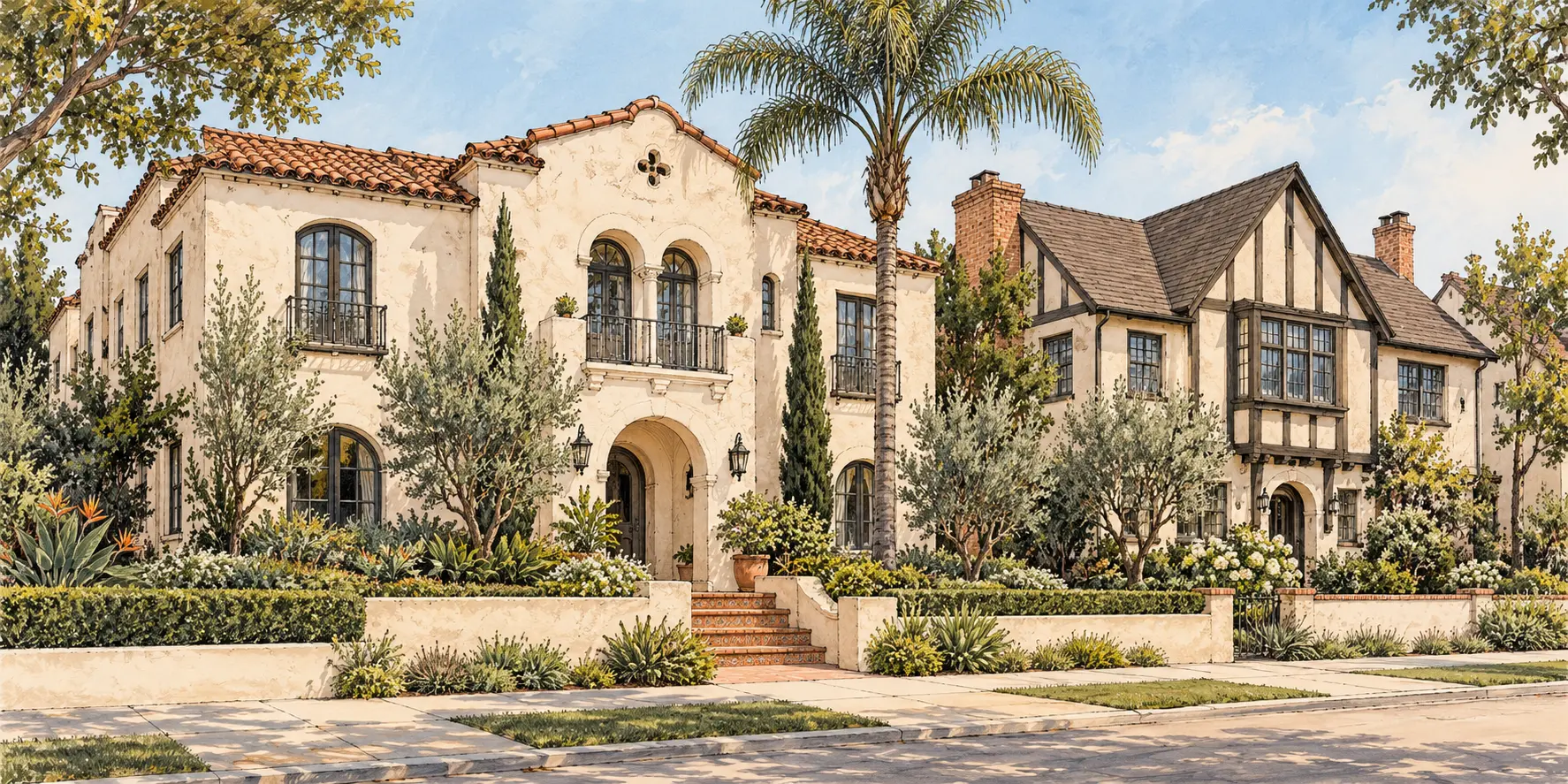
A neighborhood introduction can begin with a house: an entry arch, a tiled roof, a garden wall. But that can leave out another part of the Beverly-Fairfax story. Some of the area’s documented architectural character belongs to buildings designed for more than one household, not just the detached homes that often lead a real estate conversation.
The nearby Beverly Fairfax Historic District offers a useful example. It is a defined historic district, not another name for all of Beverly Grove or a limit on the neighborhoods this guide covers. Its records provide a more specific way to look at the streetscape, and a reminder to separate architectural appeal from assumptions about a property.
Look beyond the detached-house picture
The Los Angeles Conservancy’s account describes a district of mostly two-story multifamily homes. It documents 463 resources, including 366 contributing structures, and a mix of Spanish Colonial Revival, Tudor Revival, Monterey Revival, Art Deco and Streamline Moderne architecture.
That mix is worth noticing without turning a walk into a labeling exercise. From the public sidewalk, compare the entrances, rooflines and arrangement of windows. What draws your attention to one building? What repeats on the next? Those observations can sharpen a conversation about the architecture you enjoy. They cannot establish the legal number of units, a building’s original layout or the condition behind a finished wall.
A district record tells a different story
The National Park Service’s record for Beverly Fairfax identifies a period of significance from 1924 to 1949. It records architecture, social history and ethnic heritage as areas of significance. That is broader than a catalogue of attractive facades: the recognition concerns a place and its history, not simply a preferred decorative style.
A period of significance is not a construction date for every address. Nor should an attractive exterior be treated as proof that a building contributes to the district. When researching a particular home, keep the district record and the individual property record separate. An address-specific question deserves an address-specific answer.
Recognition took neighborhood work
The Conservancy credits a resident-led effort with pursuing the National Register nomination. Its account describes fundraising, professional research and the task of identifying property owners, culminating in listing in October 2018. The effort received a Conservancy Preservation Award in 2019.
For someone new to the area, that history offers a useful change of emphasis. The neighborhood was not documented only by looking at its most conspicuous buildings. Residents also worked to make a larger collection legible. Reading that account alongside the official record helps explain why the spaces between headline landmarks deserve attention too.
Do not let “historic” answer the wrong question
The National Park Service explains that National Register listing does not automatically create local historic-district zoning or local landmark designation. It also does not require public access to a privately owned property. Enjoy the view from public places; recognition is not an invitation to enter a garden or courtyard.
For an owner considering work, the practical step is to ask which designations and requirements apply to the exact parcel. Do not translate the federal label into either blanket permission or a blanket prohibition. The NPS distinguishes federal listing from local designation; a project-specific answer still needs the relevant authorities and advisers.
Bring better questions to a home search
Keep three columns in your notes: the features you like, the property facts that are documented and the questions still open. A striking entry belongs in the first column. Verified unit information belongs in the second. A claim about historic status that has not been checked belongs in the third.
Our property-records guide can help organize the next research step. You can also explore the neighborhood’s Market history for another layer of local context. The aim is to see more of the place without asking a beautiful building to tell you everything about itself.
Go to the source
- Los Angeles Conservancy: Beverly Fairfax nomination and preservation effort ↗
- National Park Service: Beverly Fairfax Historic District record ↗
- National Park Service: recognition, listing and ownership ↗
Sources checked November 1, 2026. The National Park Service’s listing guide states it was last updated September 10, 2025. Its district metadata and the Los Angeles Conservancy’s project account do not display publication dates. Historical recognition is not a newly announced designation or a determination of any individual property’s current status.
General architectural and historical context, not a title report, designation determination, zoning interpretation, valuation or legal advice. Confirm the exact parcel, applicable jurisdiction and current requirements with the relevant agencies and qualified advisers before relying on a property description or planning work. Our editorial policy.
A property question?
Michael and Gabriel can help you organize the real estate questions and identify the next conversations to have.
Contact Michael + Gabriel →